



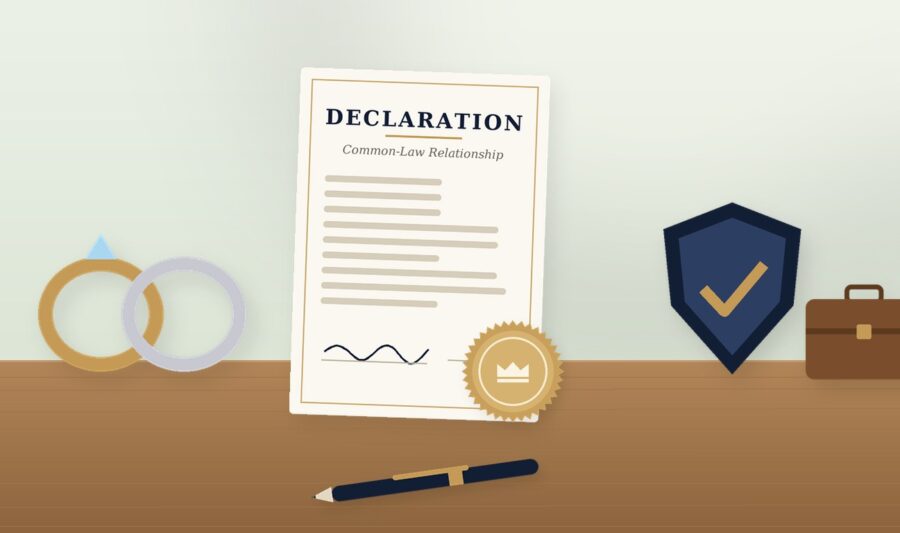
Many employers, benefit plans, pension plans and insurers let you cover a common-law partner, but they need proof that the relationship exists. Often that proof is a declaration of common-law relationship, signed in front of a commissioner or notary.
Who asks for one
- group health and dental benefit plans;
- pension plans naming a spouse or beneficiary;
- life and other insurance policies;
- some government programs and agencies.
Each organization defines “common-law” in its own way, often based on how long you have lived together. Check your plan’s definition before completing the form.
This is different from IRCC’s form
If you are applying to IRCC for immigration purposes, you will generally use the IMM 5409 form instead. See our guide to IMM 5409 common-law declarations.
Preparing for your appointment
- Use the form provided by your employer, plan or insurer, or ask whether a general statutory declaration is acceptable.
- Complete it, including the date you began living together, but leave it unsigned.
- Check whether both partners need to sign. Many forms require it.
- Bring valid photo ID for each signer.
At the appointment
We confirm each person’s identity, administer the declaration, witness the signatures and apply our stamp. We don’t advise on whether you qualify as common-law under a particular plan.
Related reading
- IMM 5409 common-law declarations
- What is a statutory declaration?
- Free template: Statutory Declaration
- What ID do you need for notarization in Ontario?
- Notary FAQs
Book with Crown Seal Notary
Crown Seal Notary serves Hamilton and the surrounding area seven days a week. In-office appointments are available at 21 King St W, 5th Floor, and our mobile service comes to your home, workplace, hospital or care home. To book, call 289-207-0851, email info@csnotary.org, or book online. You can also browse all of our services or read our FAQs.
Please note: Crown Seal Notary provides notarization and commissioning services only. We do not provide legal, immigration or financial advice, and we cannot tell you what to write in your document. If you are unsure which document you need, please check with the organization that asked for it or speak with a lawyer or licensed paralegal.