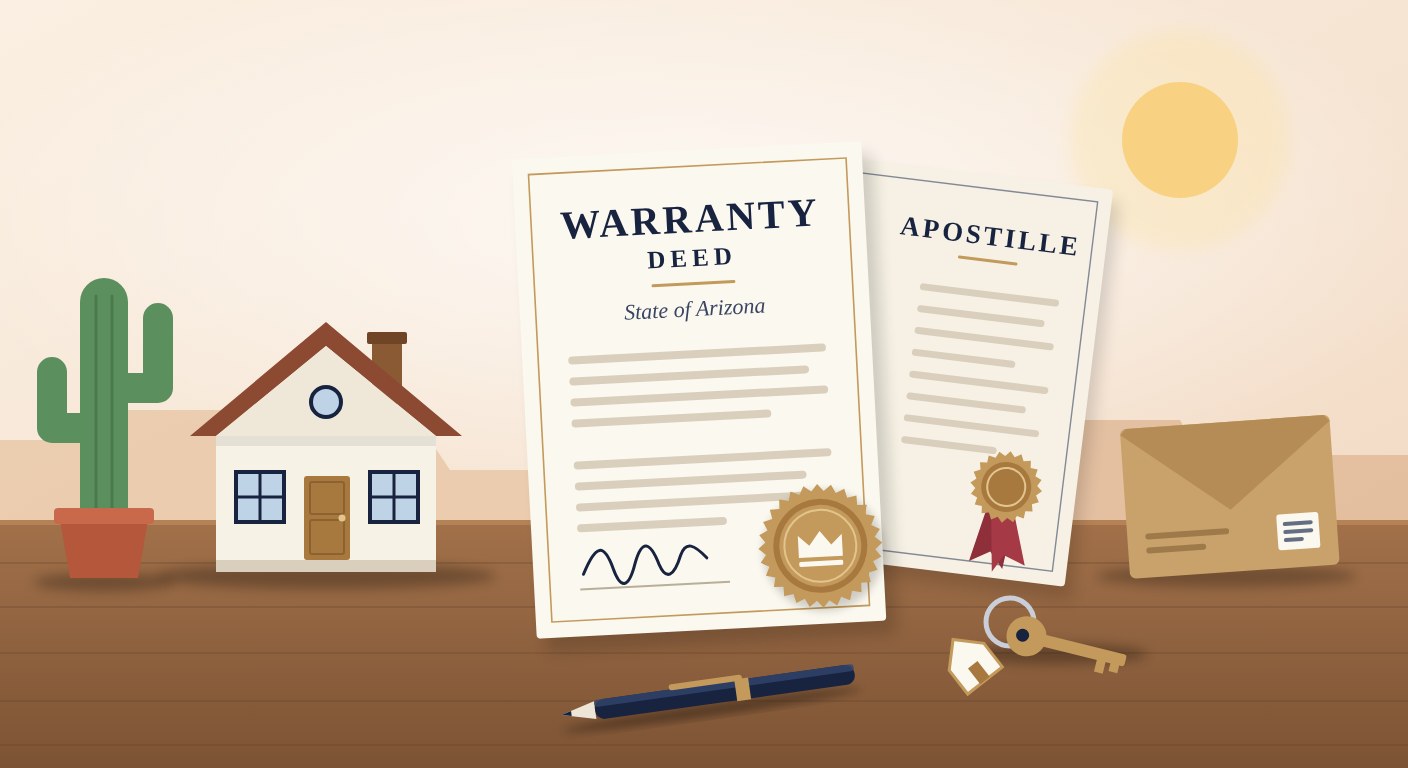




Your escrow officer in Scottsdale, Phoenix or Tucson has sent the closing package and asked for it back signed, notarized and apostilled. You are in Ontario, and winter is coming whether the paperwork is ready or not. This guide explains what Arizona asks for, what to bring to your appointment, and how Crown Seal Notary handles the notarization and the apostille request in one place.
Arizona is one of the top three states for Canadian buyers. In the National Association of Realtors’ 2025 report, 12% of Canadian buyers purchased there, and many of them spend the winter.
Arizona closing documents at a glance
- Signed and acknowledged. Arizona’s statute requires a deed to be signed by the person transferring the property and acknowledged before an authorized officer. It does not call for witnesses.
- Foreign notarial acts are recognized. Arizona law gives a notarial act performed in another country the same effect as one performed by an Arizona notarial officer.
- The apostille is conclusive. Under the same law, an apostille conclusively establishes that the notary’s signature is genuine and that the notary holds the office.
- An Affidavit of Property Value travels with the deed. The county recorder must refuse a deed that arrives without a complete one, unless an exemption applies.
- Original signatures, on letter or legal-size paper. Arizona’s recording rules ask for both.
What Arizona law asks for when you sign outside the United States
A signature and an acknowledgment
Section 33-401 of the Arizona Revised Statutes says every deed must be signed by the grantor and duly acknowledged before an authorized officer. With an acknowledgment, you declare before the notary that you signed the document. Arizona’s statute does not ask for witnesses. If your instructions ask for one anyway, follow them.
Recognition of an Ontario notary
Section 41-262 deals with notarial acts performed in other countries. It gives a notarial act performed under the authority of a foreign state the same effect in Arizona as if an Arizona notarial officer had performed it.
Why your escrow officer asks for an apostille
The same section says an apostille issued by a country that is party to the Apostille Convention conclusively establishes that the notary’s signature is genuine and that the notary holds the indicated office. Canada has been a party since January 11, 2024. For a title company that has never seen an Ontario notary’s seal, that certificate settles the question.
The Affidavit of Property Value
Under section 11-1133, a deed transferring title must be accompanied by an affidavit completed by the seller and the buyer, or their agents, on a form approved by the Arizona Department of Revenue. Your escrow officer prepares it and tells you who signs. If your copy has a notary block, bring it to your appointment with the rest of the package.
Paper, margins and original signatures
Section 11-480 sets the form of documents presented for recording: original signatures, a page no larger than 8.5 by 14 inches, print no smaller than ten-point type, and a two-inch top margin on the first page. Print the package exactly as your escrow officer sent it. Do not resize it to fit other paper, and do not print it double-sided unless told to.
Documents in a typical Arizona closing package
- a warranty deed, if you are selling;
- a deed of trust, if you are borrowing. Arizona lenders commonly secure the loan this way;
- the Affidavit of Property Value;
- a power of attorney, if someone will sign for you at closing;
- a disclaimer deed, if the title company asks a spouse who is not going on title to sign one;
- affidavits requested by the title company or lender.
Some Arizona deeds also include an acceptance section for the buyers to sign. If yours does, every buyer named there attends the appointment. We don’t draft or explain the documents, so questions about what they mean go to your escrow officer or an Arizona attorney.
How to get Arizona closing documents notarized and apostilled in Ontario
- Send us your signing instructions. Use the free document check on our appointment page. We reply by email with what to bring.
- Print the package as sent. Single-sided, at full size, on the paper your instructions call for.
- Sign in person. Bring the package unsigned, your instructions, and two pieces of identification with your name matching the documents. See what ID you need for notarization.
- We arrange the apostille. Through our apostille assistance, we prepare your notarized documents and submit them to the Ontario government for you.
- Courier the originals. Arizona records original signatures, so the paper itself has to arrive. Use a tracked courier and keep each apostille attached to its document.
How long it takes and what the apostille costs
We offer two apostille service options, so you can match the timing to your closing date.
| Service | Turnaround | Fee |
|---|---|---|
| Same-day apostille | Same day | $800 CAD |
| Regular apostille | Within 3 days | $500 CAD |
Work backward from the day the originals must arrive in Arizona: courier time, then apostille time, then your appointment. Tell us your closing date when you book, and we will confirm your total by email before you come in.
Five mistakes that delay Arizona closings
- Signing before the appointment. Bring everything unsigned.
- Sending a scan instead of the original. Ask your escrow officer whether a scan can hold the file while the originals are in transit, but plan on couriering the paper.
- Reprinting at a different size. Shrunken print and lost margins can cause trouble at the recorder’s office.
- One spouse attending for both. Each person signing must appear before the notary with their own identification.
- Booking a video appointment. Ontario does not permit remote notarization and does not issue apostilles for documents notarized by video. Our post on online commissioning in Ontario explains where video signing does work.
Arizona closing documents: common questions
Can an Ontario notary notarize an Arizona deed?
Yes. Arizona law gives a notarial act performed in another country the same effect as one performed by an Arizona notarial officer. Your closing team decides what they accept, so we follow the instructions they gave you.
Do Arizona closing documents need witnesses?
Arizona’s deed statute asks for the grantor’s signature and an acknowledgment. It does not ask for witnesses. If your lender or title company wants one, their instructions win.
Does Arizona require an apostille?
Arizona law recognizes a foreign notarial act, and it says an apostille conclusively establishes the notary’s signature and office. That is why escrow officers ask for one. If your instructions ask for an apostille, the package needs one.
We leave for Arizona next month. Can we sign before we go?
Yes, if your escrow officer has the package ready. Send us the instructions as soon as they arrive, and tell us your travel date as well as your closing date.
What is the difference between an acknowledgment and a sworn statement?
With an acknowledgment, common on deeds and deeds of trust, you declare that you signed the document. With a sworn statement, such as an affidavit, you swear or affirm that what it says is true. We complete the certificate your documents call for.
Can you come to us?
Yes. Our mobile notary service visits homes and workplaces in Hamilton and the surrounding area.
Sources
- Arizona Revised Statutes, section 33-401, section 41-262, section 11-1133 and section 11-480
- Government of Ontario: Information for notaries public in Ontario
- Hague Conference on Private International Law: Apostille Convention status table
- National Association of Realtors: International Transactions in U.S. Residential Real Estate (2025 report for state shares)
Related reading
- Notarization and apostilles for U.S. real estate closing documents signed in Ontario
- Florida closing documents: notarization and apostille in Ontario
- California closing documents: notarization and apostille in Ontario
- What documents can be apostilled in Canada?
- Notarization mistakes to avoid
Book with Crown Seal Notary
Crown Seal Notary serves Hamilton and the surrounding area seven days a week. In-office appointments are available at 21 King St W, 5th Floor, and our mobile service comes to your home, workplace, hospital or care home. To book, call 289-207-0851, email info@csnotary.org, or book online. You can also browse all of our services or read our FAQs.
Please note: Crown Seal Notary provides notarization and commissioning services only. We do not provide legal, immigration or financial advice, and we cannot tell you what to write in your document. If you are unsure which document you need, please check with the organization that asked for it or speak with a lawyer or licensed paralegal. This guide is general information and is not advice on the law of any U.S. state.