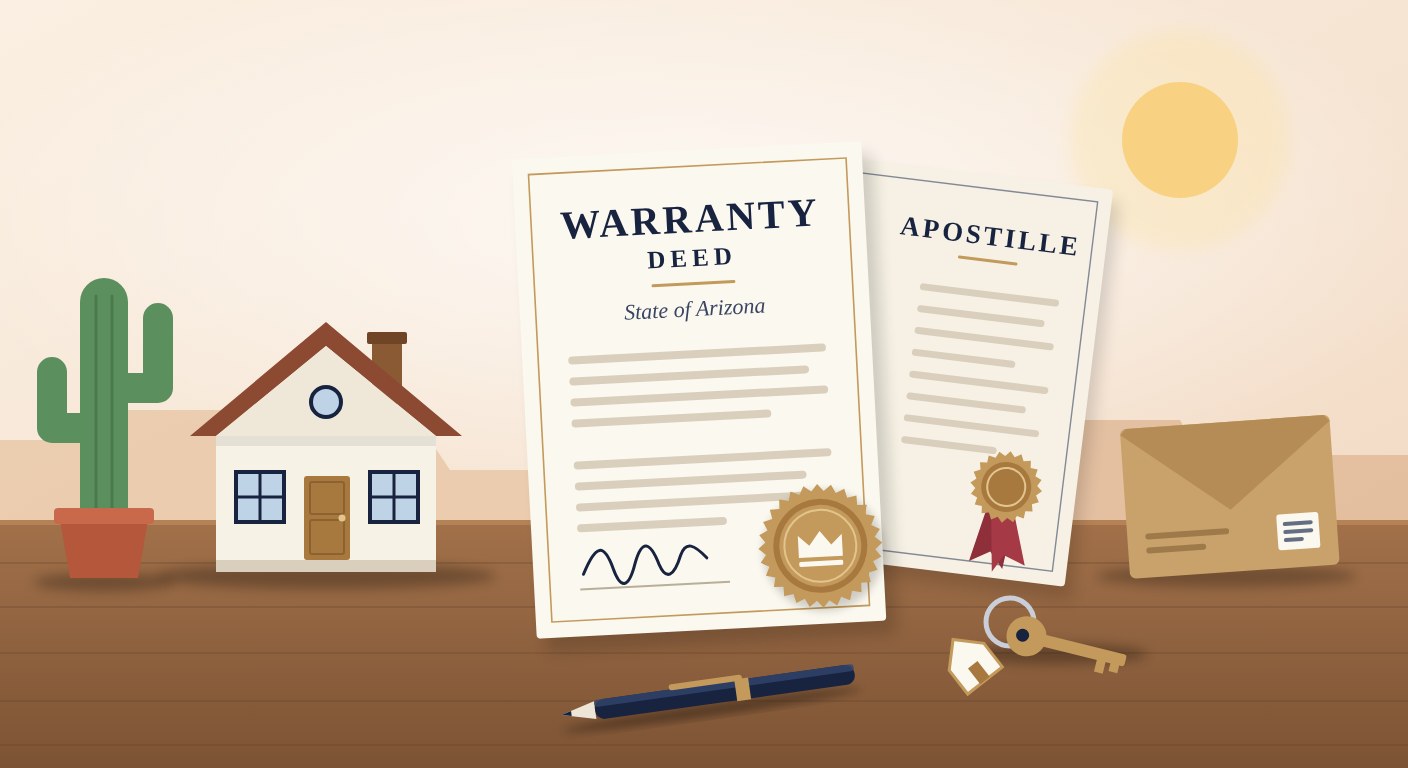





Buying, selling or refinancing a property in the United States from Ontario? Your title company, lender or closing attorney has told you to have your closing documents notarized and apostilled before you send them back. This guide explains what that means, what to bring to your notary appointment, and how Crown Seal Notary helps with both. It includes notes for Florida, California and Arizona, the three most popular states for Canadian buyers.
What “notarized and apostilled” means for U.S. closing documents
Your closing team has asked for two separate things, done by two different offices.
- Notarization is done by an Ontario notary public. The notary confirms your identity, watches you sign, administers an oath if the document is sworn, and completes a notarial certificate with a signature and seal.
- An apostille is a certificate issued by the Ontario government. It confirms that the notary’s signature and seal are genuine and that the notary holds that office. It does not review what your document says.
The notarization always comes first. The apostille is attached to the notarized document afterward. Crown Seal Notary handles the notarization and can look after the apostille request for you, so you deal with one office.
Canada and the United States are both members of the Apostille Convention, which has applied to Canada since January 11, 2024. That is why an Ontario apostille is the certificate your closing team is asking for.
U.S. closing documents we commonly notarize
- deeds transferring the property;
- mortgages or deeds of trust, if you are borrowing;
- powers of attorney allowing someone to sign for you at closing;
- affidavits and sworn statements required by the title company or lender.
Not every page in the package needs a notary. Your signing instructions will say which ones do.
Step 1: Read your signing instructions before you book
The instructions from your closing team control how the documents must be signed. Before you book, look for:
- which documents must be notarized, and which of those must also be apostilled;
- whether any document needs witnesses, how many, and who may act as one;
- what identification they expect, and whether they want copies of it;
- how the package must be printed, including paper size and ink colour. U.S. documents are often formatted for letter or legal-size paper;
- whether the notary should complete the certificate already printed on the document;
- the date the originals must arrive, and the address to send them to.
If anything is unclear, ask your closing team in writing. You can also send us the instructions through the free document check on our appointment page, and we will reply by email with what to bring.
Step 2: Have your documents notarized in Ontario
Documents that will be apostilled must be notarized in person. Ontario does not issue apostilles for documents notarized by video.
What to bring
- the full package, printed as instructed and unsigned;
- your signing instructions;
- two pieces of identification, including government-issued photo ID, with your name matching the documents. See what ID you need for notarization;
- every person who is signing, each with their own ID;
- your witnesses, if the documents call for them.
If your name appears differently on your ID and on the closing documents, tell us and your closing team before the appointment. Our post on one and the same person declarations explains one common fix.
What happens at the appointment
- We confirm the identity of each person signing.
- You sign each document in front of the notary, and in front of your witnesses where they are required.
- If a document is sworn, such as an affidavit, we administer the oath or affirmation.
- We complete the notarial certificate with the notary’s signature and seal.
Acknowledgment or sworn statement?
U.S. packages usually contain two kinds of notarized documents. With an acknowledgment, common on deeds and mortgages, you declare before the notary that you signed the document. With a sworn statement, such as an affidavit, you swear or affirm that what it says is true.
Notarized, not commissioned
A document that needs an apostille must be notarized by a notary public. A commissioner’s signature on its own is not enough. Our post on notary public vs. commissioner of oaths explains the difference.
Step 3: Getting the apostille for your closing documents
Once your documents are notarized, they need an apostille from the Ontario government before they go back to your closing team. Crown Seal Notary does not issue apostilles, but you do not have to manage that step yourself. Through our apostille assistance, we prepare your notarized documents and submit them for you.
What we need from you
- your closing date, and the date the originals must arrive;
- which documents in the package need an apostille;
- where the completed package should go.
How long does an apostille take, and what does it cost?
We offer two apostille service options, so you can match the timing to your closing date.
| Service | Turnaround | Fee |
|---|---|---|
| Same-day apostille | Same day | $800 CAD |
| Regular apostille | Within 3 days | $500 CAD |
Tell us your closing date when you book, and we will help you choose the option that fits. You can also send us your package through the free document check on our appointment page, and we will confirm your total by email before you come in.
Step 4: Send the package back
Closing dates are firm, and the apostille adds time. A little planning keeps you ahead of the deadline.
- Work backward from the day the originals must arrive: courier time, then apostille time, then your notary appointment.
- Book your appointment as soon as the package arrives. Tell us your closing date when you book, so we can talk through the timing with you.
- Ask your closing team whether they will accept scanned copies while the originals are in transit.
- Keep each apostille attached to its document. Do not remove staples or separate the pages.
- Use a tracked courier and keep copies of everything you send.
Florida, California and Arizona closing documents: what differs
The four steps are the same for every state. What changes is how the documents must be signed, and what the state’s law says about a notary outside the United States.
Florida closing documents
- Two witnesses on deeds. Florida law requires a deed to be signed in the presence of two subscribing witnesses. Arrange this before your appointment. Ask your closing team who may act as a witness and whether the notary may be one, and tell us when you book.
- Printed names and addresses. Florida’s recording rules ask for each witness’s name and post-office address printed beneath their signature. The rule has an exception for documents signed outside Florida, but complete those lines if your documents include them.
- The notary’s seal. Florida law recognizes an acknowledgment taken by a notary public of another country who has an official seal, with the certificate under that seal. The apostille then confirms the seal for your closing team.
California closing documents
- The apostille is part of the statute. When a notary outside the United States takes an acknowledgment, California’s Civil Code asks for the notary’s signature to be proved. An apostille is one of the accepted ways. County recorders apply the same rule before recording a deed.
- Certificate wording. California has its own acknowledgment wording for signings inside the state. For signings elsewhere, the Civil Code accepts a certificate taken in accordance with the laws of the place where it is made. Follow your closing team’s instruction on which certificate to use.
- Who sends your instructions. California closings are commonly handled by an escrow company, so your package may come from an escrow officer.
Arizona closing documents
- Signed and acknowledged. Arizona’s statute requires a deed to be signed by the person transferring the property and acknowledged before an authorized officer. It does not call for witnesses. If your instructions ask for one anyway, follow them.
- Notarial acts from other countries are recognized. Arizona law gives one the same effect as if an Arizona notarial officer had performed it.
- What the apostille adds. Under the same law, an apostille conclusively establishes that the notary’s signature is genuine and that the notary holds the office.
A different state?
The four steps above still apply. The signing details will come from your closing team, so start with their instructions.
What we can and can’t do
We verify your identity, witness your signature, administer oaths and complete the notarial certificate, in our office or at your location. Where an apostille is required, we can prepare your notarized documents and submit them for the apostille on your behalf. We have assisted clients with documents for U.S. closings.
We don’t draft or explain U.S. closing documents, advise on U.S. law, tax or financing, or act as your closing or escrow agent. Your title company, lender or closing attorney handles the transaction, and their instructions decide how your documents must be signed.
Common questions
Can an Ontario notary notarize U.S. real estate closing documents?
Yes. An Ontario notary public can witness your signature, administer an oath and complete a notarial certificate on documents going to the United States. Your closing team decides what they accept, so we follow the instructions they gave you.
Do I have to go to a U.S. consulate?
Not when your closing team has asked for an Ontario notarization with an apostille. Canada and the United States are both members of the Apostille Convention.
Can my closing documents be notarized online or by video?
Not if they need an apostille. Ontario requires the notary to be physically present with you, and documents notarized remotely are not apostilled. Our post on online commissioning in Ontario explains where video signing does work.
Can you handle the apostille as well as the notarization?
Yes. We offer same-day and regular apostille service. Tell us when you book that your documents need an apostille, and see our apostille assistance page for more.
My spouse and I are both signing. Do we both need to attend?
Yes. Each person signing must appear before the notary with their own identification.
Do you offer mobile notary appointments for closing documents?
Yes. Our mobile notary service visits homes and workplaces in Hamilton and the surrounding area. If your documents need witnesses, let us know when you book.
Sources
- Government of Ontario: Information for notaries public in Ontario
- Hague Conference on Private International Law: Apostille Convention status table
- Florida Statutes, section 689.01, section 695.03 and section 695.26
- California Civil Code, section 1183 and section 1189
- Arizona Revised Statutes, section 33-401, section 41-251 and section 41-262
- National Association of Realtors: Canadian purchases of U.S. residential property
Related reading
- Signing documents for property or banking abroad
- What documents can be apostilled in Canada?
- Out-of-province real estate signings
- What ID do you need for notarization in Ontario?
- Notarization mistakes to avoid
Book with Crown Seal Notary
Crown Seal Notary serves Hamilton and the surrounding area seven days a week. In-office appointments are available at 21 King St W, 5th Floor, and our mobile service comes to your home, workplace, hospital or care home. To book, call 289-207-0851, email info@csnotary.org, or book online. You can also browse all of our services or read our FAQs.
Please note: Crown Seal Notary provides notarization and commissioning services only. We do not provide legal, immigration or financial advice, and we cannot tell you what to write in your document. If you are unsure which document you need, please check with the organization that asked for it or speak with a lawyer or licensed paralegal. This guide is general information and is not advice on the law of any U.S. state.