





When you buy, sell or refinance real estate located outside Ontario, such as a vacation home in Alberta, a condo in British Columbia or a property in Atlantic Canada, the transaction is usually handled by a lawyer (or, in some provinces, a notary) licensed in that province.
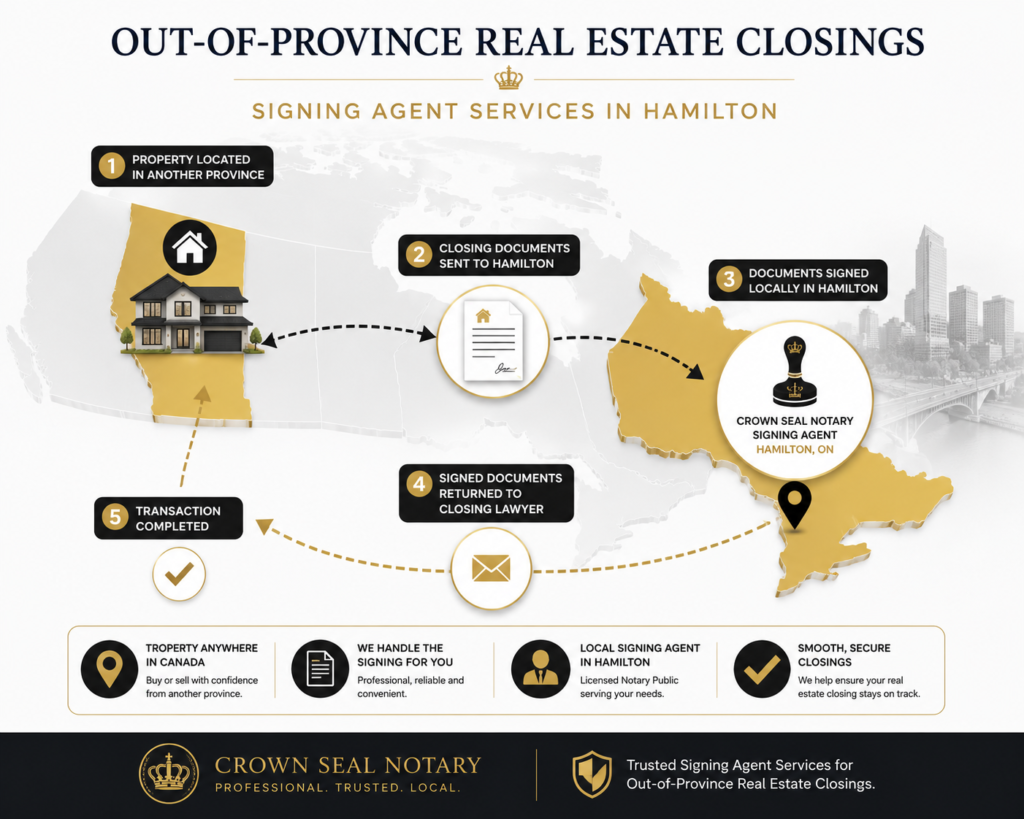
If you live in Hamilton, Halton or the GTA, travelling across the country just to sign a closing package is expensive and often unnecessary. Instead, many out-of-province lawyers email you a signing package with your mortgage documents, transfer forms and declarations, and ask you to sign it in front of a local notary public.
At Crown Seal Notary, we act as that local link. As an appointed notary public, we understand the identity checks that lenders and lawyers expect. Whether your lawyer requires in-person, wet-ink signatures (in our office or through a mobile visit) or accepts remote commissioning for certain documents, we help you get your closing documents signed before your deadline.
Please note: Crown Seal Notary does not give legal advice on your transaction. Your out-of-province lawyer or notary handles the legal work and provides the signing instructions.
COMMON DOCUMENTS WE NOTARIZE AS REAL ESTATE SIGNING AGENTS
Every province handles land registration a little differently, but an out-of-province closing package often contains documents that must be signed in front of a notary or commissioner:
- Transfers of Land & Deeds: The forms used to transfer ownership from the seller to the buyer.
- Mortgage Documents & Instructions: Documents from your lender setting out the loan terms, which require careful identity verification to help prevent fraud.
- Statutory Declarations: Sworn statements your lawyer or lender needs, for example about residency, marital status or possession.
- Dower or Homestead Consents: Used in some western provinces (such as Alberta), where a spouse who is not on title may need to consent to the sale in front of an authorized official.
- Certified True Copies of Identification: Many lenders ask the signing notary to review and certify copies of your government photo ID for the file.
HOW THE CLOSING APPOINTMENT WORKS
Real estate closings run on strict timelines. To help your appointment go smoothly, follow these steps:
Step 1: Receive & Print the Package
Your out-of-province lawyer will email you the closing package. Do not sign any pages yet. Print the whole package exactly as your lawyer instructs (for example, single-sided on letter or legal paper).
Step 2: Book Crown Seal Notary
Check whether your lawyer requires original wet-ink signatures or accepts remote signing. For wet-ink signings, book an in-office appointment or a mobile visit to your home or office. If your lawyer confirms that remote commissioning is acceptable for certain documents, you can book a remote online session for those.
Step 3: Identity Verification & Signing
Bring two valid pieces of government-issued identification, such as a passport and a driver’s licence (check your lawyer’s instructions). Our notary public will verify your identity, witness your signatures, administer any required oaths, and add our signature and seal where required.
Step 4: Return the Documents to Your Lawyer
For in-person appointments, the signed package is handed back to you to courier to your lawyer, following their instructions. For remote sessions, the commissioned documents are sent to you electronically.
FAST, RELIABLE CLOSINGS. BOOK YOUR SIGNING AGENT TODAY.
Don’t let distance disrupt your closing day. Get the careful identity verification and signing support your out-of-province lawyer needs.
Click Here to Book an In-Office or Mobile Signing Appointment